





Share Your Voice on Rural Health!
AHCCCS invites rural residents, providers, Tribal partners, community organizations, local governments, and other stakeholders to provide feedback on the Arizona Rural Health Transformation Program (RHTP). Public input will help inform AHCCCS’s funding expenditure plan and recommendations submitted to the Arizona Joint Legislative Budget Committee.
AHCCCS is hosting three regional public meetings:
Northern Arizona Meeting


Date: 7/27/26
Time: 10:30AM-11:30AM
Location: East Flagstaff Community Library. 3000 N Fourth Street, Suite 5 Flagstaff, AZ 86004
In-person attendence: Register for AZ Rural Health Transformation Regional Meetings
Virtual attendence: Register for Nothern AZ Rural Health Transformation Webinar
Central Arizona Meeting
Date: 7/30/26
Time: 1:00PM-2:00PM
Location: Arizona’s Connected Workspace – Room TR-1210. 1400 W Washington St Phoenix, AZ 85007
In-person attendence: Register for AZ Rural Health Transformation Regional Meetings
Virtual attendence: Register for Central AZ Rural Health Transformation Webinar
Southern Arizona Meeting
Date: 7/31/26
Time: 2:00PM-3:00PM
Location: Joel D Valdez Main Library – Tortolita Room. 101 N Stone Ave Tucson, AZ 85701
In-person attendence: Register for AZ Rural Health Transformation Regional Meetings
Virtual attendence: Register for Southern AZ Rural Health Transformation Webinar
Better healthcare. Closer to home.
Arizona is investing nearly $167 million in federal funding to transform healthcare in rural communities across the state — expanding access, training more providers, and strengthening the health systems that more than 786,000 Arizonans depend on every day.
Program Runs: December 2025 – October 2030
Lead Agency: Arizona Health Care Cost Containment System (AHCCCS)
Are you a…
- Rural Provider, hospital or community health organization?
Grant opportunities are coming Spring 2026. All awards will be finalized by Summer 2026. - Tribal Nation or Health Organization?
You are a priority partner. Dedicated support, technical assistance, and grant opportunities will begin Spring 2026. - Prospective vendor, or contractor?
Limited procurement opportunities are coming Spring 2026. - Member of the Public?
Learn how this program will improve health care in rural Arizona below.
The Problem We’re Solving
More than 786,000 Arizonans (11% of total population) live in rural areas where healthcare is critically strained and hard to reach.
- The nearest hospital is, on average, 20 miles away
- Some rural areas have just one behavioral health provider for every 50,000 people
- Rural residents earn $24,000 less than urban Arizonans and suffer higher rates of unemployment, chronic disease, preventable illness and injuries, and death
- Nearly half of rural women must travel more than 30 minutes for maternal care and American Indian women face maternal mortality rates 7x higher than the state average
This program is Arizona’s most significant investment in rural health in a generation. It is designed to improve healthcare access, build a stronger rural health workforce, and create lasting change.
What We’re Funding
Arizona’s program is built around four areas of investment. Funding flows to rural hospitals, clinics, Tribal health programs, universities, nonprofits, and community organizations working in these areas.
Arizona’s RHTP proposal focuses on four strategic goals:
- Rural Health Workforce Development
- Priority Health Initiatives
- Expanding Access to Care
- Strengthening Rural Health Systems
These efforts are designed to improve health outcomes while making care more affordable and reliable.
Building the Rural Health Workforce
$43 million per year | Led by the Arizona Office of Economic Opportunity (OEO)
Too many rural communities can’t find or keep doctors, nurses, and behavioral health providers. We’re fixing that through the Rural Health Workforce Training and Development Program by funding financial incentives and supports to recruit and retain medical staff, as well as expansions to rural health education and training programs, residencies, career pipelines starting in K-12.
Tackling the Biggest Health Challenges
$31 million per year | Led by the Arizona Department of Health Services (ADHS) and AHCCCS
Targeted public health grants address behavioral health and substance use disorder (SUDs), maternal-fetal health, and chronic disease prevention and management — the issues hitting rural Arizonans hardest.
Expanding Access to Care
$38 million per year | Led by AHCCCS
We’re meeting patients where they are — through telehealth, mobile clinics, and innovative care models that bring services to communities instead of making communities travel long distances to receive them.
Strengthening Rural Health Systems
$38 million per year | Led by AHCCCS
Rural hospitals and clinics often operate on razor-thin margins. We’re helping providers share costs, modernize operations, and build the financial stability to serve their communities long-term.
Who We’re Working With
This program only works through partnership. Arizona is working closely with:
- 22 Federally recognized Tribal Nations — through government-to-government consultations, not checkbox engagement.
- Critical Access Hospitals and rural clinics across all rural counties
- Public Arizona universities and community colleges building the next generation of rural providers
- Local and county health departments and community-based organizations
- Arizona’s Governor’s Office, AHCCCS, OEO, and ADHS — coordinating as one team
Funding Opportunities
How Arizona Is Distributing RHTP Funds
Beginning in Spring 2026, Arizona will use a range of competitive and direct award grant programs to distribute RHTP funding to organizations doing work on the ground.
Types of Funding Mechanisms
- Requests for Grant Applications (RFGA) — competitive, open solicitations for eligible organizations
- Cooperative Agreements — collaborative funding arrangements for larger, multi-year partnerships
- Intergovernmental Agreements (IGAs) — formal agreements with Tribal governments, local health departments, and other state agencies
- Contract Amendments — modifications to existing agreements with managed care plans and established providers
- Multi-Tier Grants — we’re designing flexible awards with grant tiers as small as $10,000 and up so organizations of all sizes can apply.
Technical Assistance & Support
Technical assistance will be available to help smaller organizations apply and administer funds. Dedicated technical assistance for Tribal Nations and tribal health organizations will also be available.
For Vendors and Contractors
All RHTP contracts and subawards include applicable federal and state requirements. Administrative costs for all funds are capped at 10% per federal requirements, no exceptions. Vendors providing products and services to grantees should be prepared meet federal audit standards (2 CFR Part 200, Single Audit requirements for entities expending $1 million in federal funds).
Active Solicitations
View the AHCCCS Grants Initiatives page.
- Opioid Antagonist Distribution Initiative
- procurement and distribution of opioid antagonist kits such as naloxone for first responders, rural clinics, Tribal community health representatives, school nurses, and community partners;
- overdose recognition and response training for volunteer EMS, rural firefighters, and county public health workers;
- rural readiness support such as medication storage and emergency communications;
- Tribal partnership support to equip community members and paraprofessional responders with localized overdose prevention protocols.
RFGA Released: July 10, 2026
Provides rural counties, Tribal communities, small fire districts, and frontier clinics with expanded capacity to prevent and respond to opioid overdoses.
Funded activities include:
Opioid Antagonist Distribution Initiative RFGA Application:
- FY2026 Cooperative Agreements for States and Territories to Improve Local 988 Capacity
- Application deadline: July 17, 2026
- Expected Award Date: 9/1/2026
- Expected Start Date: 9/30/2026
- Length of Project Period: 3 years
The purpose of this program is to improve state and territory response to all 988
contacts (including calls, chats, and texts) originating in the state/territory and improve
service for populations at high risk of suicide and overdose.
Frequently Asked Questions
Who can receive funding?
Funding goes to organizations, not individuals. This includes local governments, hospitals, universities, community colleges, community health centers, nonprofits, rural health associations and consortiums, federally recognized Tribes, and more. Specific eligiblity wil be listed with each grant opportunity.
Are Tribal communities included?
Yes — as a top priority. Ongoing government-to-government Tribal Consultation with 22 federally recognized Tribes in Arizona will continue throughout the five-year program. Prospective grant applicants are strongly encouraged to demonstrate meaningful partnership and engagement with Tribal health organizations across all four investment areas.
How do I know if my organization qualifies?
Check back when applications open — eligibility criteria will be clearly listed. When in doubt, reach out. We’d rather help you figure out if you’re eligible than have you not apply.
Is this just for healthcare providers?
No. Universities, community colleges, nonprofits, social service organizations, and Tribal and local governments are all potential partners and applicants depending on the program area.
When will money actually start flowing?
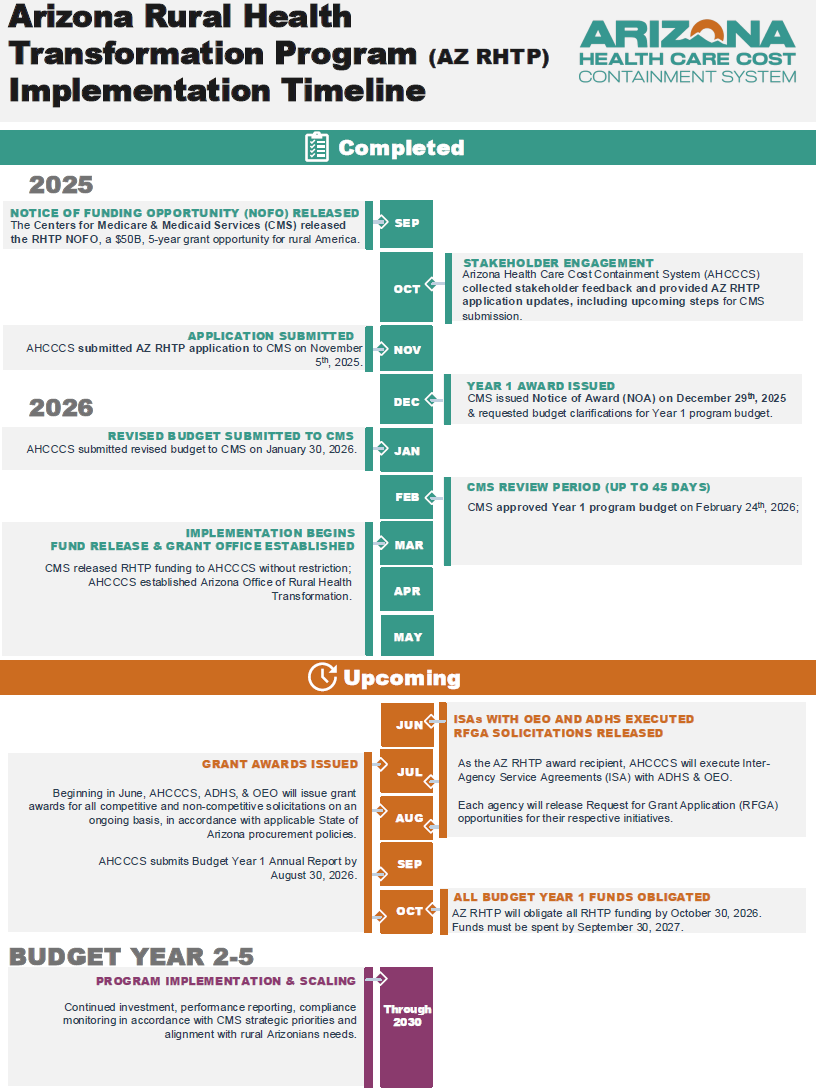
Year 1 funding is targeted to be fully committed by October 30, 2026. Grantees have until September 30, 2027 to spend funds.
RHTP Executive Committee
Coming Summer 2026
The RHTP Steering Committee will be established by Governor Hobbs to provide executive recommendations on implementation and program direction on an ongoing basis for the full five-year program. It will include senior leaders from AHCCCS, ADHS, OEO, the Governor’s Office, and rural health stakeholders.
Meeting schedules, members, and materials will be posted here once the committee is active.
Staying Connected
Arizona is committed to transparency and collaboration throughout RHTP implementation, including:
- Ongoing stakeholder engagement, with listening sessions, advisory groups, and regular updates
- Community-centered implementation, including programs led by agencies with strong rural experience
- Clear accountability, encompassing regular reporting and public updates on progress
- For questions, please contact RHTP@azahcccs.gov
Resources
Disclaimer: This website is supported by the Centers for Medicare & Medicaid Services (CMS) of the U.S. Department of Health and Human Services (HHS) as part of a financial assistance award totaling $166,988,955,92 with 100 percent funded by CMS/HHS. The contents are those of the author(s) and do not necessarily represent the official views of, nor endorsement, by CMS/HHS, or the U.S. Government.