





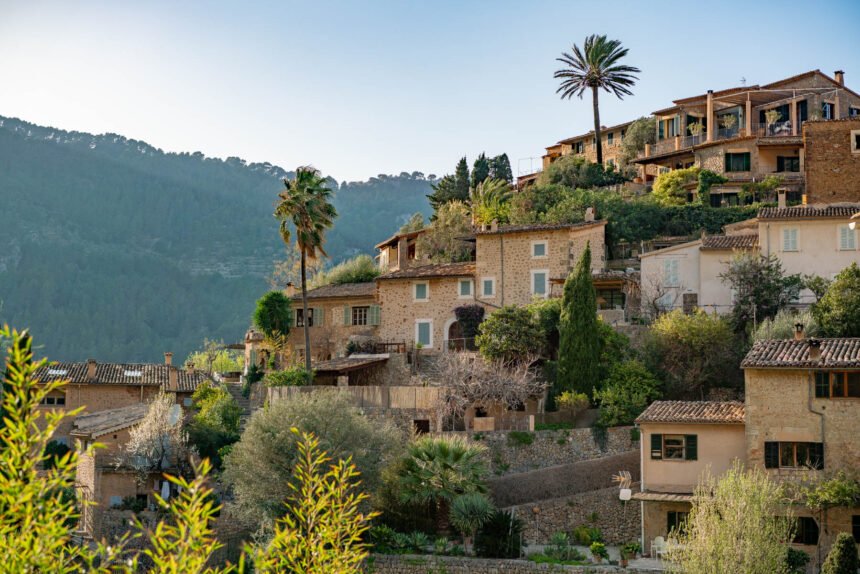
If you only have one day to leave Palma, this is the day trip to do.
The drive along the Serra de Tramuntana through Valldemossa, Deià, and Sóller is one of the most beautiful in Europe and it hits three completely different villages in about 50km. We’re talking a medieval monastery town, a tiny clifftop artists’ village, and a sun-soaked mountain town surrounded by orange groves.
I’ve done a lot of day trips from a lot of cities. This one is genuinely special. Here’s exactly how to do it.
The Route (and Why This Order Works)
Start in Palma heading north. Valldemossa is first and only 25 minutes from the city. From there it’s 20 minutes further to Deià, then another 20 minutes to Sóller. Coming back, you take the Sóller tunnel straight to Palma in about 30 minutes (€5 toll) or drive over the Coll de Sóller pass if you want more mountain views and don’t mind adding 15 minutes.

Going in this order is important. You hit Valldemossa before the tour buses show up around 10am. You land in Deià right around lunchtime when you actually want to be there. And you end in Sóller for the afternoon, which is the most relaxed of the three and the best place to wind down before driving back.
If you flip the order you’ll be fighting crowds in Valldemossa, starving in Sóller, and trying to get a lunch reservation in Deià at 3pm. Don’t flip the order.
If you’re spending more time on the island, check out our full guide to things to do in Mallorca and our one week in Mallorca itinerary.

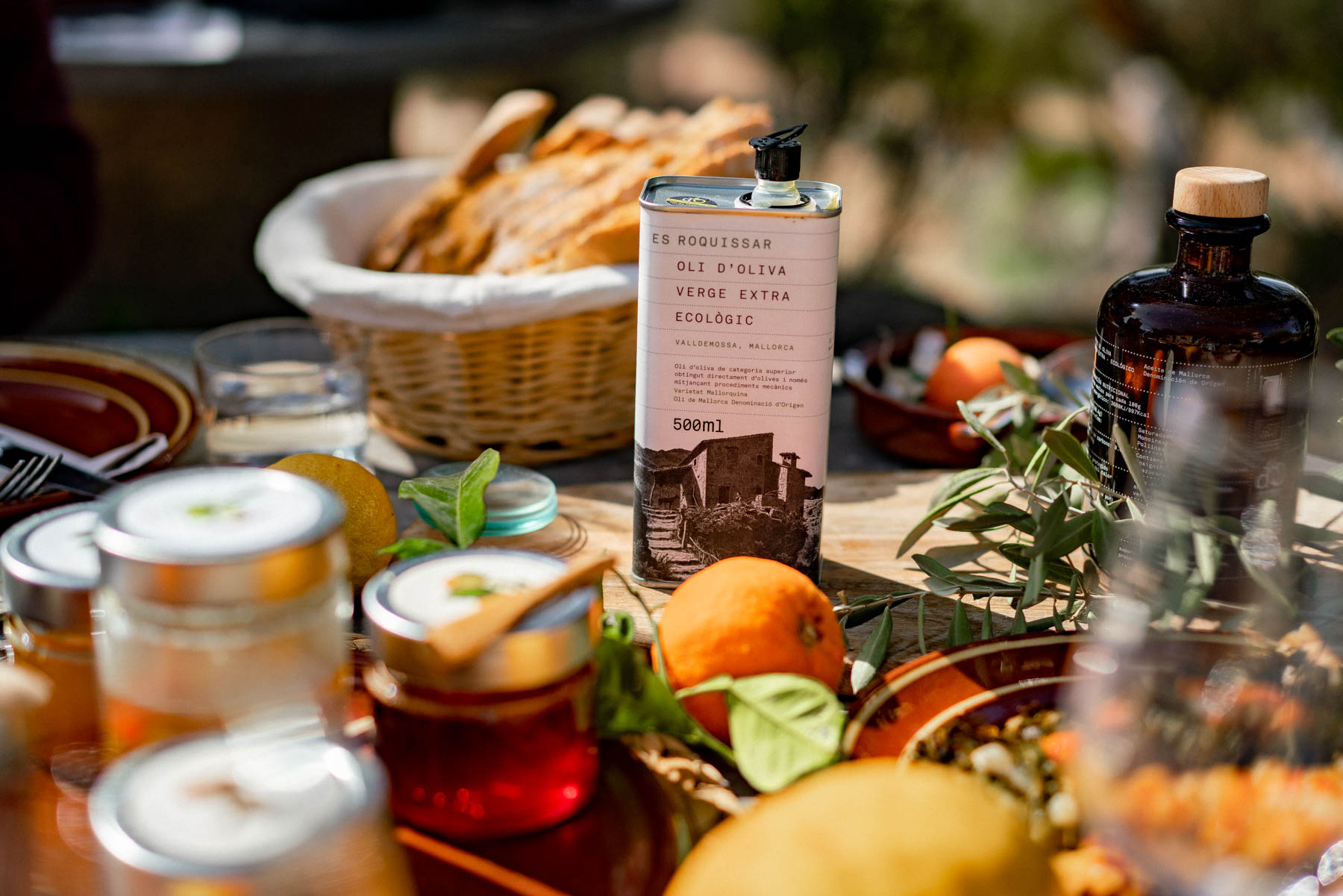
Valldemossa (Start Here by 9:30)
Valldemossa is the kind of village that looks like it was built specifically for Instagram. Honey-colored stone buildings, flower pots on every doorstep, narrow lanes that lead to mountain views. It’s also genuinely historic and not just a pretty face.
The main attraction is the Real Cartuja, the monastery where Chopin and George Sand spent their famous (and famously miserable) winter of 1838-39. Sand came here hoping the Mallorcan climate would cure Chopin’s tuberculosis. It did not. Instead, it rained constantly, the locals were suspicious of them, and Sand ended up writing A Winter in Majorca, a book that essentially drags the entire island for 200 pages.
The irony is that Sand’s complaints are a big part of what made Valldemossa famous. Tourists have been coming here to see where she was miserable ever since. You kind of have to respect it.
The monastery is open at 10am and costs about €9.50. Budget 1 to 1.5 hours to walk through the monks’ cells, Chopin’s piano (one of two originals on display), and the old pharmacy with its antique ceramic jars. The courtyard has one of the best views in the village. You can see the entire valley from there, with terraced hillsides dropping away to the south and the Tramuntana peaks rising behind you.
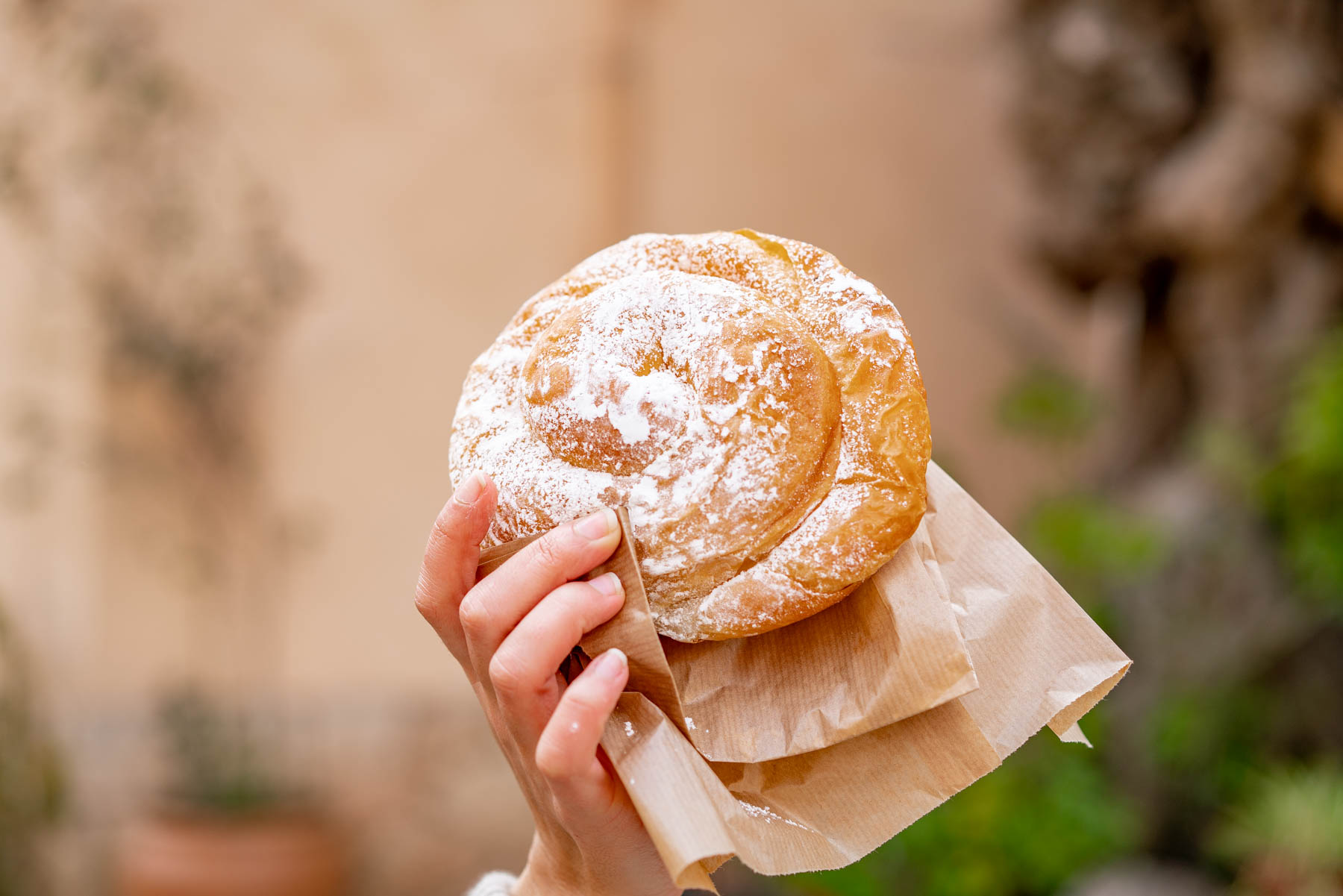
Before or after, walk the stone streets and buy a coca de patata. This is a sweet potato pastry that’s unique to Valldemossa and every single bakery in town makes them. They’re soft, slightly sweet, dusted with powdered sugar, and genuinely good. Get one. Or three.
Before or after the monastery, wander the streets around Carrer de la Beata. The stone houses have terracotta roof tiles and bright green shutters, and every single doorstep has a potted plant or flower box. It feels like a village that has been quietly competing in a beautification contest for 400 years.
Don’t linger more than 1.5 hours here. The village is gorgeous but tiny and you have two more stops that are just as good. The tour buses start arriving around 10am so getting there by 9:30 is key. By 10:30 the main street is shoulder-to-shoulder and the charm evaporates fast.


The Drive to Deià (The Best 20 Minutes)
The Ma-10 from Valldemossa to Deià might be the most scenic short drive on the entire island. I don’t say that lightly. We’ve driven a lot of coastal roads and this one had both of us just staring out the window.
Tight switchbacks hug the cliffs with the Mediterranean hundreds of meters below. The Tramuntana mountains rise above you on the other side. It’s 20 minutes of the kind of driving where you keep saying “pull over, pull over” but there’s nowhere to pull over.
Except at Son Marroig. This was the estate of Archduke Ludwig Salvator, the Austrian royal who fell in love with Mallorca in the 1870s and basically never left. There’s a small museum (€4 entry) but the real draw is the white marble temple on the cliff edge with panoramic views over the coast. You can actually photograph the temple from the road without paying, but the views from inside the grounds are worth the four euros.


Deià (Lunch at the Rocks)
Deià is Robert Graves’ village. The English poet and novelist first came here in 1929, left during the Spanish Civil War, and returned in 1946 to stay for good. He wrote I, Claudius here, along with dozens of other books, and lived in Deià until his death in 1985. His grave is in the village cemetery up by the church, marked with a simple inscription. His house on the Carretera is now a small museum and worth a quick visit if you’re curious about what a writer’s life looked like in rural Mallorca for half a century.
But Graves wasn’t the only one. This tiny village (population 700) has attracted artists, musicians, and writers for decades. Ava Gardner and the Rolling Stones both spent time here. These days it mostly attracts people with a lot of money and very good taste.
The village itself is beautiful in a different way than Valldemossa. More Mediterranean, more overgrown, more the kind of place where you’d want to rent a stone house for a month and write something pretentious. Walk through the lanes. Appreciate it. But don’t spend too long up here because the main event is down at the water.
Cala Deià is a rocky cove about 20-25 minutes on foot from the village center. It’s a steep walk down (and a much steeper walk back up). You can also drive down but there are maybe 15 parking spots and in summer they’re gone by 11am. I’d walk.
Fair warning. This is not a sand beach. It’s pebbly and rocky and you’ll want water shoes if you plan to swim. But the water is deep and absurdly clear, that electric Mediterranean blue that makes you want to quit your job and move to an island. On a calm day it’s one of the prettiest swimming spots in Mallorca. Just don’t expect a towel-on-soft-sand situation.
At the bottom you’ll find Ca’s Patró March, a restaurant literally built into the rocks above the cove. This is one of the most famous restaurants in Mallorca and for good reason. Fresh fish, grilled prawns, simple preparations, and a setting that is genuinely absurd. You’re eating on a terrace over the Mediterranean with waves crashing below. Budget €40-60 per person. Book at least a few weeks ahead in summer because everyone knows about this place.
If you can’t get a reservation (it happens), you have options. Ses Roques is right next door with a similar waterfront setting and slightly less insane demand. Or skip the cove entirely and eat at El Barrigón up in the village. It’s a tiny tapas bar with excellent local wine and plates that cost a fraction of what you’d pay at the water. Honestly, on our second visit we chose El Barrigón on purpose. Sometimes good tapas and a mountain view beats fighting for a cliffside table.
For more restaurant recommendations across the island, see our guide to the best restaurants in Mallorca.
The walk back up from Cala Deià is the real workout of the day. Steep, no shade, and you just ate a large lunch. It’s fine. You earned it.


Sóller (Afternoon and Ice Cream)
After the drama of the coastal drive and the steep hike at Cala Deià, Sóller feels like a deep breath. It’s a pretty mountain town sitting in a valley of orange groves, and the vibe is more “let’s sit in the square and have a coffee” than “let’s climb something.”
The Plaça Constitució is one of the best town squares in Mallorca, and I’d argue it’s underrated even by people who’ve been. The church of Sant Bartomeu has a facade designed by Joan Rubió, who was a student of Gaudí, and you can see the influence immediately. It has that same organic, almost melting quality. Next to it there’s an Art Nouveau bank building (Banco de Sóller) with an ornate iron-and-glass facade that looks like it belongs in Barcelona, not a small mountain town.
Grab a table at one of the outdoor cafes, order a cortado, and just exist for a while. You’ve earned it after that Cala Deià climb.
If you want some culture, the Can Prunera museum is a modernist house turned art museum with works by Picasso, Miró, and other big names. It’s a nice surprise in a town this size.
The real move in Sóller is taking the antique tram down to Port de Sóller. It’s about 5km and costs around €6 one way. The tram is wooden, old, and rattles through orange groves on its way to the coast. The valley around Sóller is famous for its orange and lemon groves. They’ve been growing citrus here since the Moors, and in spring the whole valley smells like orange blossoms. Even in summer you’ll see the fruit hanging heavy on the branches from the tram window.
At the port you’ll find a horseshoe-shaped bay, a decent beach, and waterfront restaurants. If you have time, walk to the lighthouse at the far end of the bay. It’s about 30 minutes each way and the views back across the harbor are lovely. For food, Ca’n Pintxo does excellent paella with a direct view of the boats bobbing in the harbor. It’s not fancy but the rice is good and the setting does all the hard work.
It’s not the most beautiful beach in Mallorca (for that, check our best beaches in Mallorca guide) but it’s a pleasant spot to end the afternoon.
Before you leave Sóller, get ice cream at Sa Fàbrica de Gelats. They make their sorbet from local Sóller oranges and lemons and it is outstanding. The orange sorbet specifically. Get it. This is not optional.


Getting Back to Palma
You have two options and they’re both good.
The Sóller tunnel takes about 30 minutes and costs €5 in toll. It’s fast, easy, and gets you back to your hotel or your Airbnb in time for a shower before dinner. The Ma-11 over Coll de Sóller pass skips the toll, adds about 15 minutes, and gives you one last round of mountain views. If it’s not dark yet and you’re not exhausted, take the pass. The views are a nice final act.
There’s also the Tren de Sóller, a historic wooden train that runs from Sóller back to Palma. It takes about an hour, costs around €25 each way, and passes through tunnels and across a viaduct with valley views. It’s touristy but genuinely fun. The catch is that if you take the train, your car is stuck in Sóller. So this really only works if you took the train to Sóller from Palma in the first place, which is a whole different day trip plan.


Tips for This Day Trip
Leave Palma by 9am. This gives you time to reach Valldemossa before the tour buses and sets up the whole day properly.
Wear comfortable walking shoes. Between the cobblestones in all three villages and the steep descent to Cala Deià, this is not a flip-flop day. I learned this the hard way.
Book Ca’s Patró March in advance. In summer, weeks ahead. If you can’t get a table, El Barrigón in Deià village does excellent tapas and is much easier to get into.
Bring cash. Parking meters in the villages and the Sóller tunnel toll both take cash. Some accept cards now but don’t count on it.
Fill up in Palma. Gas stations are sparse once you’re in the mountains.
Parking is a whole thing. Valldemossa has a paid lot on the outskirts of the village. Use it. Do not try to drive into the center unless you enjoy three-point turns on medieval streets with an audience. Deià has almost no parking and what exists fills up early. The small lot near the church is your best bet. Sóller is the easiest of the three with parking near the train station.
Wear sun cream even if it’s cloudy. The mountain air feels cool but you’re still in the Mediterranean and the UV is real. I got burned on an overcast day in April. Not fun.
The total drive is about 50km from Palma and back. That’s not far in distance but the mountain roads are slow. Give yourself the full day. Trying to rush this route defeats the entire purpose.
Don’t rush. The mountain roads are narrow but well-paved and perfectly safe if you’re paying attention. This day is about the drive as much as the stops. Roll the windows down. Pull over when you see a view. That’s the whole point.